Particle-sensitive laboratory operations require more than controlled air quality and specialized equipment. Every surface in your workspace can influence contamination risks, cleaning efficiency, and process consistency. An improperly designed table may trap particles in joints, release contaminants through surface degradation, or obstruct routine cleaning. By engineering your work surfaces around material compatibility, structural design, and contamination-control requirements, you can create a more reliable laboratory environment.
A properly specified cleanroom table supports sensitive activities such as electronics assembly, pharmaceutical preparation, medical device manufacturing, and precision laboratory testing. The key is to evaluate how the table interacts with your room classification, cleaning procedures, equipment, and daily workflows before selecting a design.
Define Your Cleanroom Requirements
Start by identifying the sensitivity of your laboratory operations. Different applications have different requirements for particle control, chemical resistance, static electricity, and surface cleanliness.
Consider these factors before specifying your table:
Cleanroom classification: Determine the applicable ISO classification and the cleanliness requirements for your process.
Contamination sensitivity: Identify whether airborne particles, fibers, chemical residues, or electrostatic discharge could affect your materials.
Cleaning protocols: Document the disinfectants, solvents, and cleaning agents used in your facility.
Operational loads: Calculate the combined weight of instruments, samples, fixtures, and other equipment.
Workflow requirements: Establish the usable surface area, working height, and access needed by laboratory personnel.
These details help you define measurable performance criteria rather than choosing a table based on appearance or price alone.
Select Materials That Minimize Particle Contamination
Material selection directly affects the durability, cleanability, and contamination performance of your work surface.
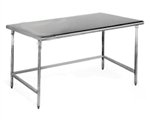
Stainless steel is a common choice for cleanroom environments because its smooth, nonporous surface can be cleaned effectively when properly finished and maintained. Grade 304 stainless steel suits many general laboratory applications, while grade 316 stainless steel may be preferable when greater resistance to certain corrosive chemicals is required. Actual suitability depends on chemical concentrations, exposure duration, and cleaning conditions.
Other materials may be appropriate for specialized processes. Phenolic surfaces, for example, can provide useful chemical resistance for particular laboratory applications, while conductive or static-dissipative materials may be necessary when handling electrostatic-sensitive components.
When evaluating materials, check:
- Surface finish and resistance to scratches.
- Compatibility with cleaning agents and disinfectants.
- Potential for corrosion, flaking, or fiber shedding.
- Suitability for the required static-control measures.
- Compatibility with temperature and chemical exposure.
Choose a material that meets your actual operating conditions instead of assuming that one material is suitable for every cleanroom.
Engineer the Table Structure for Easy Cleaning
A cleanroom table must be designed so you can clean its entire structure without leaving inaccessible contamination traps.
Focus on construction details such as:
Smooth welds: Specify finished joints that minimize crevices and residue accumulation.
Sealed frame openings: Prevent exposed hollow tubing from collecting particles inside.
Rounded edges and corners: Make wiping easier and reduce hard-to-reach areas.
Minimal fasteners: Avoid unnecessary exposed screws, threads, and overlapping components.
Accessible undersides: Leave enough clearance to clean beneath the table and around its legs.
These features are especially valuable in laboratories where operators perform frequent disinfection or handle sensitive materials. A well-engineered table also reduces the time needed for routine cleaning and inspection.
Match the Tabletop Design to Airflow Requirements
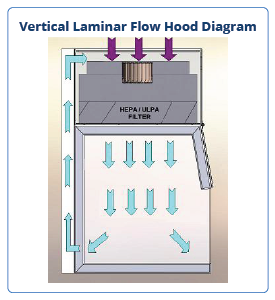
Your table should support the room’s airflow strategy rather than interfere with it. This is particularly important when you perform particle-sensitive operations beneath HEPA-filtered unidirectional airflow.
Choose between solid and perforated tabletops based on the process:
Solid tabletops: Suitable for general laboratory preparation, equipment placement, sample handling, and tasks requiring a continuous surface.
Perforated tabletops: May support airflow passage in appropriately designed unidirectional-flow workstations, depending on the system configuration.
Specialized work surfaces: May be necessary when your process requires static dissipation, chemical resistance, or precise measurement.
Do not assume that a perforated table automatically improves cleanliness. Hole geometry, equipment placement, airflow velocity, and the position of the work surface can affect performance.
Before installation, assess the table within the intended room layout. Confirm that instruments, shelves, operators, and other furniture will not obstruct critical airflow paths. Where required, perform airflow visualization and particle testing as part of the facility’s qualification process.
Calculate Load Capacity and Workspace Dimensions
Mechanical stability is essential when your table supports analytical instruments, precision assemblies, or sensitive laboratory samples.
Estimate the total operating load by adding the weight of every instrument, fixture, container, and accessory that may be present simultaneously. Consider whether the load is evenly distributed or concentrated at particular points.
Next, determine the appropriate tabletop dimensions by measuring your equipment footprint and the space needed for operator movement, sample preparation, and cleaning.
Evaluate these practical requirements:
Load capacity: Verify the manufacturer’s rated capacity and any applicable point-load limitations.
Work height: Select a comfortable height for seated or standing operations.
Stability: Minimize vibration when using balances, microscopes, or precision instruments.
Mobility: Use locking casters only when movement is necessary and compatible with contamination-control requirements.
Clearance: Preserve access for cleaning, maintenance, and equipment servicing.
A table that is too small can cause clutter, while an oversized table may disrupt airflow or restrict movement. Balance usable workspace with the needs of your controlled environment.
Integrate Ergonomics and Electrostatic Control
Cleanroom engineering should account for both contamination prevention and operator performance.
Select a working height that reduces unnecessary reaching, bending, and repetitive strain. Position frequently used instruments within comfortable reach, and avoid overcrowding the work surface with accessories.
If your laboratory handles electronic components, semiconductor devices, or other electrostatic-sensitive materials, evaluate the need for a static-dissipative tabletop, grounding points, and compatible personnel grounding equipment. Verify that the complete workstation meets your process-specific electrostatic discharge requirements.
Keep cables organized and minimize unnecessary attachments. This improves accessibility during cleaning and reduces clutter around sensitive operations.
Validate the Table After Installation
Selecting an appropriate design is only the first step. You must also confirm that the installed table performs as intended within your cleanroom.
Use a practical acceptance checklist:
- Inspect surfaces, welds, edges, and frame openings for defects.
- Confirm that the table remains stable under its intended operating load.
- Verify material compatibility with approved cleaning agents.
- Check that the table does not obstruct critical airflow patterns.
- Test grounding and static-control features where applicable.
- Document inspection findings, cleaning procedures, and maintenance requirements.
Where your quality system requires it, include the workstation in the facility’s contamination-control assessment and qualification documentation. Remember that a cleanroom-compatible table alone does not establish compliance with an ISO cleanroom classification; the room and its operating conditions must be evaluated using the applicable procedures.
For additional guidance on selecting laboratory furniture and equipment, explore CleaTech LLC.
Choose a Cleanroom Table That Fits Your Application
The right table combines cleanable construction, suitable materials, structural reliability, and compatibility with your laboratory workflow. Instead of focusing exclusively on the initial purchase price, evaluate cleaning time, expected service life, maintenance requirements, and the consequences of contamination-related downtime.
Review the available cleanroom tables and laboratory workstations for contamination-sensitive operations to identify configurations that align with your workspace requirements.
If your application involves unusual dimensions, specialized instruments, static-sensitive components, or demanding cleaning protocols, discuss those requirements before finalizing your specification. You can Contact us today to discuss your laboratory equipment needs.
Frequently Asked Questions
1. What is the best material for a cleanroom table?
Stainless steel is widely used because it is durable, nonporous, and easy to clean. Grade 304 suits many general applications, while grade 316 may be more appropriate for certain corrosive environments. The best material depends on your cleaning chemistry, process requirements, and contamination-control objectives.
2. How does cleanroom table design reduce particle contamination?
Smooth surfaces, sealed openings, finished welds, and minimal crevices reduce areas where particles and residues can accumulate. These features also make routine cleaning more effective and help limit contamination associated with surface deterioration.
3. Should you choose a solid or perforated cleanroom tabletop?
Choose a solid tabletop when you need a continuous work surface for equipment and sample handling. Consider a perforated design when the airflow system requires air to pass through the table. Always evaluate the tabletop alongside your actual airflow configuration and operating procedures.
4. Can a standard stainless steel table be used in a cleanroom?
Not necessarily. Stainless steel alone does not make a table suitable for controlled environments. You should evaluate its surface finish, joints, exposed fasteners, frame construction, cleaning compatibility, and potential effect on airflow before installation.
5. How do you maintain a cleanroom table?
Follow a documented cleaning schedule using approved agents and compatible wipes. Inspect the surface for scratches, corrosion, damaged welds, and loose components. Verify grounding features where applicable, and record maintenance activities according to your laboratory’s quality procedures.
6. What should you consider when buying a cleanroom table?
Assess cleanroom classification, material compatibility, tabletop dimensions, load capacity, ergonomics, airflow requirements, static-control needs, and cleaning accessibility. Confirm that the proposed configuration meets your operational requirements before ordering.